#include "bsdec.h"#include "bsdec-vlc.h"#include <stdint.h>#include <string.h>#include "common/hardware/cop2.h"#include "common/hardware/pcsxhw.h"#include "common/kernel/pcdrv.h"#include "common/syscalls/syscalls.h"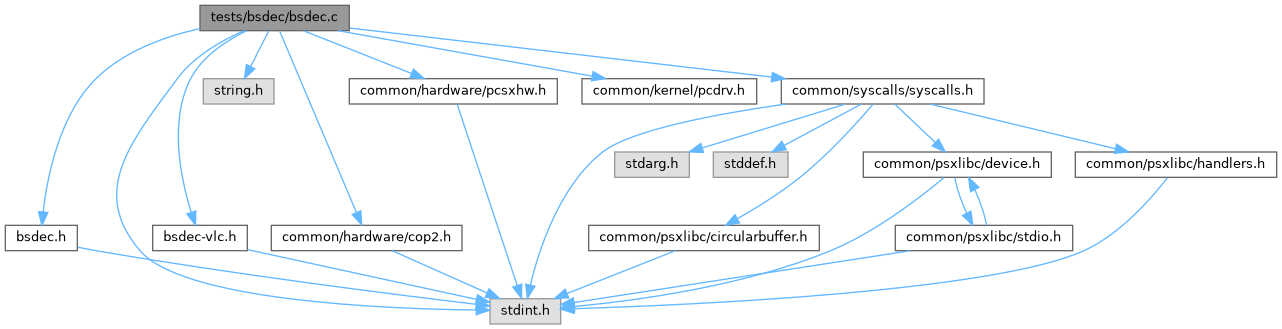
Classes | |
| struct | BsdecBits |
Macros | |
| #define | PROF2() 0 |
| #define | PROF2_ACC(t0, acc) ((void)(t0)) |
| #define | PROF_COUNT(f) ((void)0) |
| #define | PROF_ADD(f, n) ((void)0) |
| #define | BSDEC_HALF(base, feed) ((uint32_t)(base)[feed] | ((uint32_t)(base)[(feed) + 1] << 8)) |
| #define | MAX_IN (96 * 1024) |
| #define | MAX_HW (64 * 1024) |
| #define | testClz32(v) ((uint32_t)((v) ? __builtin_clz(v) : 32)) |
Functions | |
| uint32_t | bsdecRlHalfwords (const void *in, uint32_t inBytes) |
| How many run-level halfwords a frame decodes to. | |
| struct BsdecResult | bsdecFrame (const void *in, uint32_t inBytes, uint16_t *out, uint32_t outHalfwords) |
| Decode one BS frame into MDEC run-level halfwords. | |
| int | main () |
Macro Definition Documentation
◆ BSDEC_HALF
◆ MAX_HW
| #define MAX_HW (64 * 1024) |
◆ MAX_IN
| #define MAX_IN (96 * 1024) |
◆ PROF2
| #define PROF2 | ( | ) | 0 |
◆ PROF2_ACC
| #define PROF2_ACC | ( | t0, | |
| acc | |||
| ) | ((void)(t0)) |
◆ PROF_ADD
| #define PROF_ADD | ( | f, | |
| n | |||
| ) | ((void)0) |
◆ PROF_COUNT
| #define PROF_COUNT | ( | f | ) | ((void)0) |
◆ testClz32
| #define testClz32 | ( | v | ) | ((uint32_t)((v) ? __builtin_clz(v) : 32)) |
Function Documentation
◆ bsdecFrame()
| struct BsdecResult bsdecFrame | ( | const void * | in, |
| uint32_t | inBytes, | ||
| uint16_t * | out, | ||
| uint32_t | outHalfwords | ||
| ) |
Decode one BS frame into MDEC run-level halfwords.
in must be halfword aligned - the bit reader walks the payload in halfword pairs - and in practice it is, since a frame arrives in sector payloads. out needs bsdecRlHalfwords(in, inBytes) entries.
The output is always a complete frame of exactly that many halfwords whenever bsdecUsable() holds, whatever the bitstream did: a partially decoded block is discarded, a short bitstream is padded with end-of-block markers, and a bitstream carrying more than its header declares is cut at the declared length. That is deliberate - a video decoder that refuses a damaged frame outright drops a frame where it could have shown most of one.
◆ bsdecRlHalfwords()
How many run-level halfwords a frame decodes to.
Read straight out of the header, so it costs two bytes and can be called before every decode. This is the size out must have. Returns 0 if the buffer is too short to hold a header.