Stackful coroutine whose stack is the scratchpad. More...
#include <psyqo/coroutine.hh>
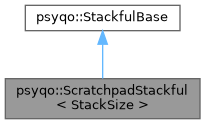
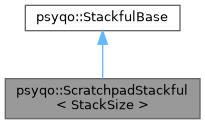
Public Member Functions | |
| ScratchpadStackful ()=default | |
| ScratchpadStackful (const ScratchpadStackful &)=delete | |
| ScratchpadStackful & | operator= (const ScratchpadStackful &)=delete |
| void | initialize (eastl::function< void()> &&func) |
| Initialize the coroutine with a function. | |
| void | resume () |
Resume the coroutine. See Stackful::resume. | |
| void | yield () |
Yield the coroutine. See Stackful::yield. | |
| bool | isAlive () const |
Check if the coroutine is currently alive. See Stackful::isAlive. | |
Static Public Attributes | |
| static constexpr uintptr_t | c_stackBase = 0x1f800400 - StackSize |
| static constexpr unsigned | c_stackSize = StackSize |
| static constexpr unsigned | c_freeBytes = 1024 - StackSize |
Additional Inherited Members | |
 Protected Member Functions inherited from psyqo::StackfulBase | |
| void | initializeInternal (eastl::function< void()> &&func, void *ss_sp, unsigned ss_size) |
| void | resume () |
| void | yield () |
| bool | isAlive () const |
| StackfulBase ()=default | |
| StackfulBase (const StackfulBase &)=delete | |
| StackfulBase & | operator= (const StackfulBase &)=delete |
Detailed Description
class psyqo::ScratchpadStackful< StackSize >
Stackful coroutine whose stack is the scratchpad.
Same as Stackful, except that the stack is not part of the object: it is the top StackSize bytes of the 1KB scratchpad, growing down from 0x1f800400. The scratchpad answers a load in one cycle where main RAM takes several, so a hot routine that spends its time saving and restoring registers and reloading spilled locals gets faster by running here. The scratchpad-stack example measures it.
The constraints all come from the scratchpad itself:
- Only one can be alive at a time, since every instance uses the same bytes. Let one return before initializing the next.
- DMA cannot reach the scratchpad, so a local of the coroutine cannot be a DMA source or target. That includes a primitive or fragment built on its stack and then chained to the GPU.
- The bottom
c_freeBytesbytes are left for data, such as variables placed with__attribute__((section(".scratchpad"))), which the linker allocates from 0x1f800000 upward.initializeaborts if the linked.scratchpadsection, which ends at__scratchpad_end, reaches into the stack. A stack that overflows at run time still writes over that data silently. - Only the main link's
.scratchpadsection is checked: data an overlay module places in the scratchpad is not accounted for. - Interrupts do not run on this stack: psyqo's exception handler saves the registers it needs to fixed addresses and switches to its own stack before calling into C++.
- Template Parameters
-
StackSize The number of bytes taken from the top of the scratchpad. A multiple of 8, at most 1024.
Constructor & Destructor Documentation
◆ ScratchpadStackful() [1/2]
|
default |
◆ ScratchpadStackful() [2/2]
|
delete |
Member Function Documentation
◆ initialize()
|
inline |
Initialize the coroutine with a function.
- Parameters
-
func Function to be executed by the coroutine.
◆ isAlive()
|
inline |
Check if the coroutine is currently alive. See Stackful::isAlive.
◆ operator=()
|
delete |
◆ resume()
|
inline |
Resume the coroutine. See Stackful::resume.
◆ yield()
|
inline |
Yield the coroutine. See Stackful::yield.
Member Data Documentation
◆ c_freeBytes
|
staticconstexpr |
◆ c_stackBase
|
staticconstexpr |
◆ c_stackSize
|
staticconstexpr |
The documentation for this class was generated from the following file:
- psyqo/coroutine.hh
